-
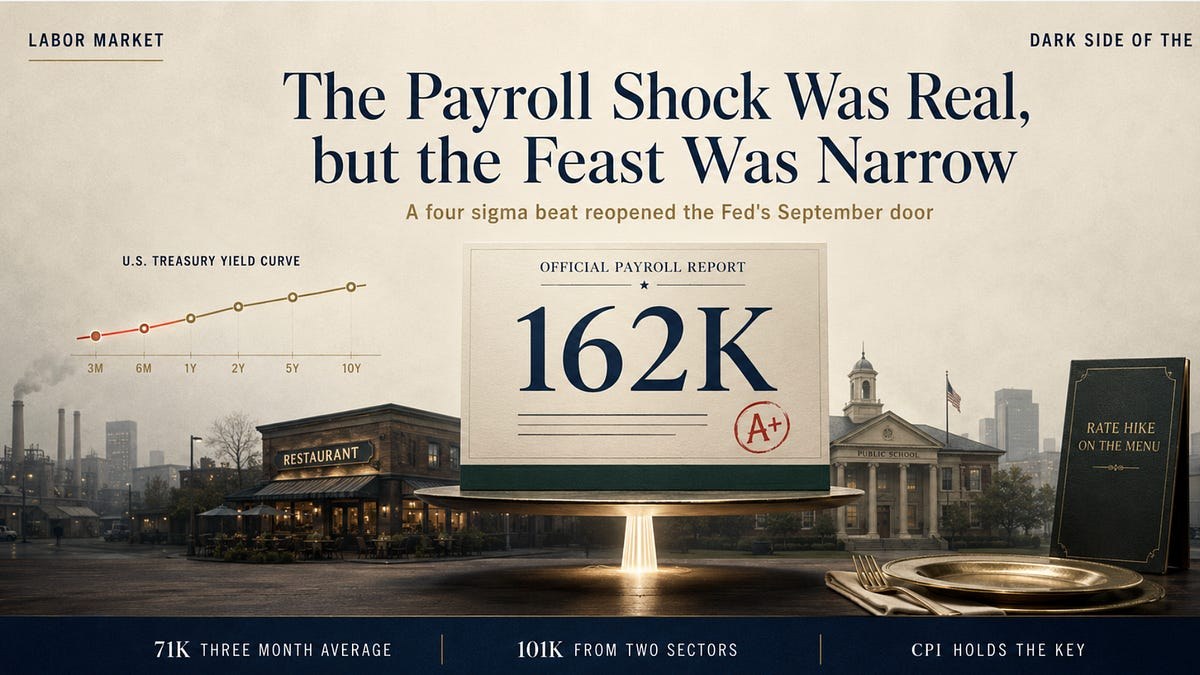
The 162,000 payroll gain was a genuine shock, beating the highest forecast and accompanied by 55,000 in positive revisions.
-
The household survey strengthened the report as employment, participation and full-time work all increased, although substantial labour slack remains outside the headline unemployment rate.
-
Nearly two-thirds of the payroll gain came from restaurants and local government education, leaving the broader hiring picture much cooler than the headline.
-
Payrolls put a September hike back in play, but moderate wage growth leaves CPI and PPI holding the deciding vote.
The Payroll Shock Was Real
August delivered a four-sigma headline, cleaner revisions and much better household detail. The trouble for the growth bulls is that most of the hiring came from a surprisingly small corner of the economy.
The US jobs machine did not merely beat expectations in August. It drove straight through the top of the forecast range and parked itself back in the middle of the September Fed debate.
Nonfarm payrolls rose by 162,000, more than three times the consensus estimate near 50,000 and comfortably above the highest forecast of 125,000. On the distribution of economists’ estimates, that was roughly a four sigma surprise. In trader language, the market was not leaning the wrong way by a few degrees. It had its compass pointed toward a different coastline.
That is why the first reaction was the old good news is bad news routine. The economy produced too many jobs for investors who had spent the past month rebuilding the case for a patient Fed. The report did not guarantee a September hike, but it put the dish back on the Friday night dinner menu just as traders had started clearing the table.
The headline deserves respect because it did not arrive alone. June payrolls were revised up by 11,000 to 31,000, while July was lifted by 44,000 from a reported loss of 23,000 to a gain of 21,000. That added 55,000 jobs back into the previous two months and removed the most alarming feature of the July report, namely the idea that payroll growth had slipped outright into reverse.
Still, this is where the first layer of excitement needs to be peeled back. After the revisions, payroll growth over June, July and August averaged roughly 71,000 per month. The August gain was also dramatically stronger than the average monthly increase of only 31,000 over the previous twelve months.
That is a meaningful slowdown from the hotter phases of the cycle and looks more like a labour market finding a lower cruising speed than an engine suddenly returning to full throttle. August was a genuine upside shock, but one strong month does not turn a 71,000 three-month average or a 31,000 twelve-month average into a new hiring boom.
The more encouraging signal came from the household survey. In recent months, payrolls and household employment had been telling increasingly different stories, with the establishment survey still adding jobs while the number of employed Americans drifted lower. August finally pulled those two narratives back toward the same page.
Household employment jumped by 569,000 to 162.746 million, while the labour force expanded by an even larger 683,000. That combination allowed the participation rate to edge up to 61.6% while unemployment held at 4.1%.
There was also a notable improvement in the quality of household employment. Full-time jobs increased by 735,000 while part-time employment fell by 223,000. The number of people working part time for economic reasons dropped by 414,000 to 4.4 million. Those are not the fingerprints of a labour market held together entirely by temporary shifts and involuntary reductions in hours.
The caveat is that household survey data are notoriously noisy from month to month, and a 683,000 jump in the labour force should not be treated like an engraved invitation to extrapolate. The report is stronger because the household survey confirmed the direction of the payroll number, but confirmation for one month is not the same as a settled trend.
The participation rate remains half a percentage point below its January level, and the employment-to-population ratio was unchanged at 59.1%, both over the month and compared with January.
The broader pool of unused labour did not suddenly disappear either. Some 5.7 million people outside the labour force said they wanted a job but were not counted as unemployed because they had not searched during the previous four weeks or were unavailable to start. Within that group, 1.7 million remained marginally attached to the labour force, and 441,000 were classified as discouraged workers.
Meanwhile, 1.9 million people had been unemployed for at least 27 weeks, leaving the long-term unemployed at 27% of the jobless total. The labour market looks healthier for people already inside it than for those trying to force their way back through the door.
The demographic detail was mostly steady rather than spectacular. Unemployment was 4.0% for adult men and 3.5% for adult women. The White unemployment rate held near 3.7%, compared with 6.0% for Black workers and 4.8% for Hispanic workers. Asian unemployment declined to 3.2%, while the teenage rate edged back up to 14.1%, largely reversing its July improvement.
None of that changes the macro conclusion, but it reinforces the sense that August was a large employment move inside an unemployment picture that barely budged.
Wages did not turn the report into an inflation grenade. Average hourly earnings rose ten cents, or 0.3%, to $37.75 and were 3.1% higher than a year earlier, broadly maintaining the recent pace rather than breaking higher. Production and nonsupervisory earnings rose eleven cents, also 0.3%, to $32.53.
The average workweek edged up by one tenth to 34.4 hours, while the production and nonsupervisory workweek held at 33.8 hours. Manufacturing hours ticked higher to 40.5, although factory overtime was unchanged at 3.1 hours.
That increase in the overall workweek matters because companies often work existing staff harder before committing to another round of hiring. Combined with the payroll gain and steady wage growth, it points to a respectable increase in aggregate labour income. Consumers received more hours, more jobs and a little more pay, which is a better combination for spending than the payroll headline alone suggests.
Yet the absence of a wage breakout also means the report did not deliver the sort of inflation signal that would force the Fed’s hand on its own.
The hiring composition is where the report becomes more complicated. Food services and drinking places added 59,000 jobs, almost five times their average monthly gain over the previous year. Local government education added another 42,000, largely reversing the prior month’s decline and leaving employment in that category little changed since January 2025.
Together, those two sectors accounted for 101,000 jobs, or nearly two thirds of the entire payroll increase.
That concentration does not make the headline false, but it makes it less muscular than 162,000 looks at first glance. Restaurant hiring can be volatile, while the education gain appears to contain a large element of seasonal payback.
Manufacturing offered the cleaner cyclical signal, adding 16,000 jobs and lifting factory employment by 58,000 from its December 2025 low. Machinery producers and fabricated metal manufacturers each added 6,000.
Construction added 22,000, while nonresidential specialty trade contractors contributed 8,000, broadly matching their average pace over the previous year. Those gains suggest the economy retains some industrial backbone even if the breadth was hardly overwhelming.
The other side of the ledger was less comfortable. Health care added only 13,000 jobs, well below its average monthly gain of 32,000 over the previous year. Home health services added 11,000 and hospitals added 8,000, implying that weakness elsewhere in the sector absorbed part of those gains.
Information employment fell by 23,000 after losing an average of 8,000 jobs per month during the previous year. Computing infrastructure, data processing and web hosting lost 8,000 jobs, publishing shed 7,000, and broadcasting and content providers lost 5,000.
Employment changed little across mining and energy, wholesale and retail trade, transportation and warehousing, financial activities, professional and business services, social assistance and other services. That is a long list of industries that failed to participate meaningfully in a supposed blowout. So while the headline shouted acceleration, much of corporate America barely cleared its throat.
The right conclusion is that the report was strong enough to kill the immediate labour market scare but too concentrated to prove the economy has rediscovered broad-based hiring. Revisions repaired the recent history, household employment supplied welcome confirmation, full time work improved and hours increased.
Against that, the three-month average remains modest, participation is still lower than at the start of the year, long-term unemployment is sticky, and the sector breadth was narrow.
Markets initially traded the number exactly that way. JPMorgan’s pre-release framework had warned that anything above 95,000 could produce a decline of roughly 0.5% to 1.25% in the S&P 500, and 162,000 sailed well beyond that threshold.
September hike odds rose to about 59% from 52%. The two-year Treasury yield jumped roughly 7.6 basis points to 4.41%, compared with increases of about 3.2 basis points in the ten-year yield and one basis point in the thirty-year. That bear flattening is the bond market’s way of saying this was primarily a Fed shock, not an unchecked celebration of growth.
The dollar gained 0.3%, gold fell 1.7% to around $4,392 and S&P 500 futures slipped, although Nasdaq futures initially held slightly firmer. Reuters captured the initial cross asset reaction here.
This is the heart of the good news is bad news trade. A stronger labour market is positive for incomes, consumption and earnings, but markets do not price those benefits in isolation. They also have to discount future cash flows through a higher risk-free rate.
When investors are already wrestling with elevated real yields, expensive equity multiples and a Fed whose inflation credibility is under inspection, an upside payroll shock raises the financing bill before it raises the earnings forecast.
The report therefore changes the Fed conversation without finishing it. Payrolls have removed the easiest argument for staying on hold, which was that hiring had become too fragile to tolerate another increase. But wages at 3.1% and unemployment at 4.1% do not demand an immediate hike. The deciding vote now belongs to next week’s CPI and PPI reports.
If inflation prints hot, the jobs report will have cleared the runway for a September move. The Fed could tighten without appearing to kick an economy already falling down the stairs.
If inflation is benign, policymakers can still argue that a 71,000 three month payroll average represents rebalancing rather than overheating, especially with hiring concentrated in restaurants and local education.
That leaves the market with a familiar but uncomfortable setup. The labour report was too strong to dismiss, not broad enough to declare a boom and not inflationary enough to settle the policy argument. It reopened the September door, but CPI still holds the key.
The full details are available in the official US Bureau of Labor Statistics release.