VOO sits 6.2% below its $718.47 high; a close above $680.26 opens $698 | That’s TradingNEWS
Key Points
- VOO closed at $673.19 on Nov. 17, down 1.04%, its fourth straight loss and 3.6% below the Nov. 11 close of $698.35.
- The S&P 500 hit a five-month low of 7,340.53 on Nov. 17, then traded at 7,348.25 Wednesday after Nvidia’s beat.
- Nvidia posted $115.8B of revenue, up 103%, and guided to $130B, yet the 10-year yield holds at 5.10%.
The Vanguard S&P 500 ETF (VOO) trades at $673.90 on Wednesday afternoon, November 18, up 0.11% from Tuesday’s close of $673.19, in line with the S&P 500 at 7,348.25. The session has swung both ways. The index opened higher on Nvidia’s results, fell to 7,305 by 11:30 a.m. ET, down 0.48%, and has since climbed back above Tuesday’s close. The Nasdaq Composite is up 0.5% and the Dow is down 0.78%. VOO’s move tracks the index, with each fund share worth 0.09171 of an S&P 500 point.
The past week has been the weakest stretch for the fund since the summer. VOO closed at $698.35 on November 11, then lost ground in four straight sessions: $696.00 on November 12, $693.38 on November 13, $680.26 on November 16 and $673.19 on November 17. Tuesday’s 1.04% drop took the S&P 500 to 7,340.53, a five-month low. Over five sessions, the index is down 3.53%. VOO now trades 3.5% below the November 11 close and 6.2% below its 52-week high of $718.47.
The thesis for this forecast is that the S&P 500’s slide is a rate and positioning event, not an earnings event, and that VOO’s dip into the $668 to $674 zone offers a recovery to $698.35. Earnings remain strong: Nvidia, the index’s largest company, reported revenue up 103% to $115.8 billion and guided to $130 billion. What has changed is the cost of money. The 10-year Treasury yields 5.10%, markets price a 97.8% chance of a Fed hike on December 9, and funds have sold stocks to raise cash for Anthropic’s $64 billion IPO. Those pressures are temporary in a way that earnings weakness would not be.
The levels are clear. Support starts at $673.19, Tuesday’s close, then $668.27, Tuesday’s intraday low, equal to 7,287 on the S&P 500. Below that, $646.62 marks a 10% decline from the 52-week high, the threshold for a correction. Resistance starts at $680.26, the November 16 close, then $693.38 and $698.35, the November 11 close. The upside target is $698.35, 3.6% above the current price and equal to 7,615 on the S&P 500. A daily close above $680.26 opens the target. A daily close below $660.00 would point toward the correction line.
Why VOO Fell Four Straight Days: Yields, a Software Rout and IPO Funding
Tuesday’s selling was broad. All 11 sectors of the S&P 500 fell, and the index lost 1.03% while the Dow fell 1.64% and the Nasdaq 0.74%. The VIX, which measures expected volatility, rose 11% to 25.46. The trigger was a combination of three forces: rising rate expectations, a sell-off in software stocks and funds raising cash for Anthropic’s IPO.
Rates are the largest force. The 10-year Treasury yields 5.10%, the 2-year 4.80% and the 30-year 5.46%. Markets price a 97.8% chance of a 25-basis-point Fed hike on December 9, after hotter-than-expected inflation data last week. When the risk-free rate rises above 5%, the value of future corporate earnings falls, and stocks with long-dated earnings, such as technology, fall most. VOO’s 30%-plus weighting in technology makes it sensitive to that math.
Software took the hardest hit. On Tuesday, Salesforce fell 9.41%, ServiceNow 6.47%, Intuit more than 6% and Workday 5%, as investors worried that AI agents will reduce demand for software sold per user. The software ETF lost 3.29% and Microsoft 2.27%. Those companies make up a large share of the S&P 500’s technology weight, and their declines pulled the index lower even as chip stocks held up better.
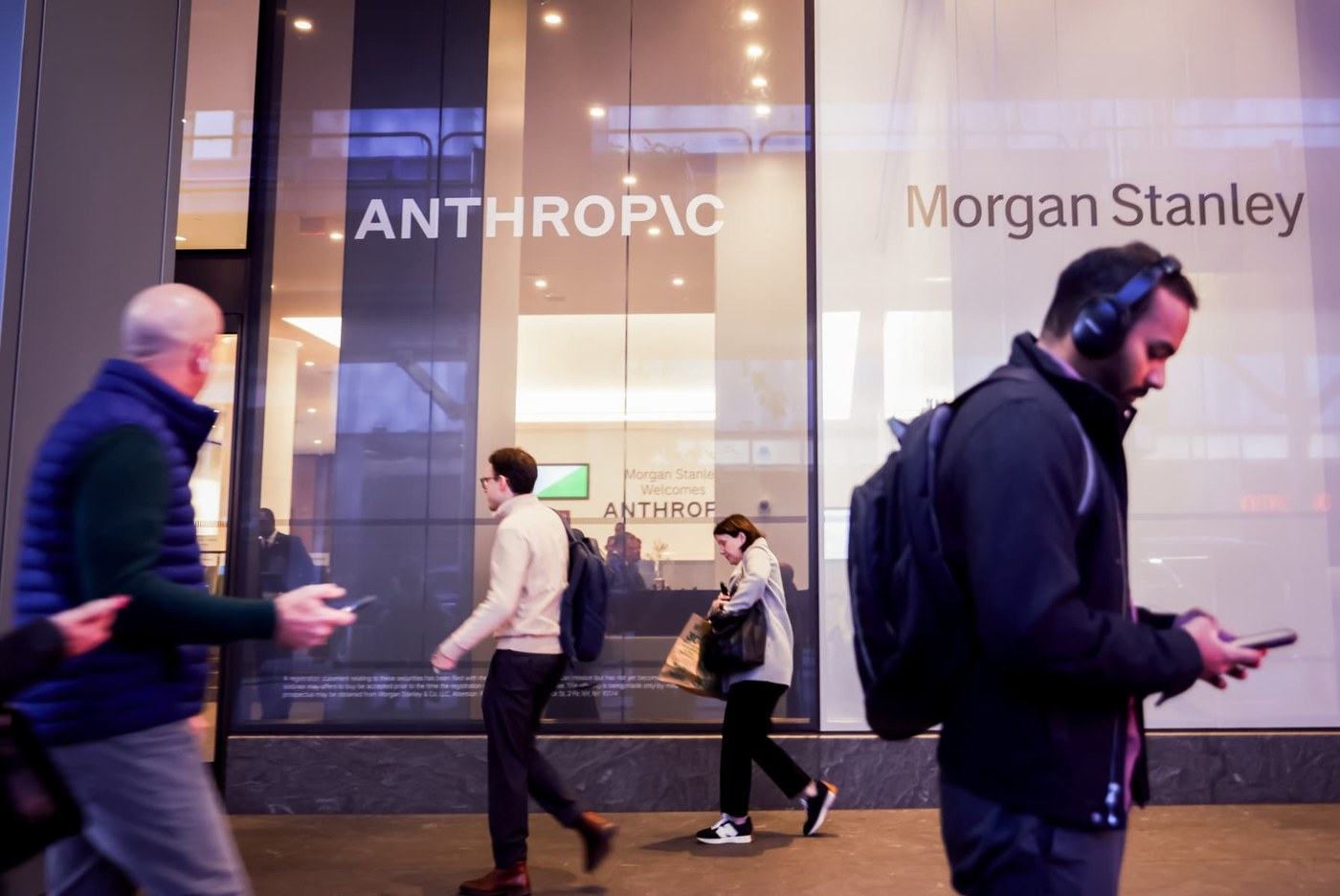
IPO funding added pressure. Anthropic is set to price as much as $64.4 billion of shares on Wednesday evening, guiding toward the top of or above its $70 to $78 range, with orders reported at almost seven times the shares available. Large funds that want allocations need cash, and they raised it by selling liquid stocks. In June, around SpaceX’s IPO, the Nasdaq-100 rose 3% from four sessions before the listing to four after, while software lagged. The current pattern looks similar, with the selling concentrated before the listing.
The selling is about valuation and rates, not earnings. The S&P 500’s trailing P/E is 22.74, which gives an earnings yield of 4.40%, 70 basis points below the 10-year Treasury yield. When bonds pay more than the earnings yield on stocks, investors demand lower stock prices or higher earnings growth. That gap explains why Nvidia’s strong report did not lift the index more: the market is pricing the discount rate, not the earnings.
Nvidia’s $115.8 Billion Quarter: The Index’s Largest Holding Delivers
Nvidia reported fiscal third-quarter revenue of $115.84 billion on Tuesday evening, up 103% from a year earlier and above the $109.1 billion consensus. Adjusted earnings were $2.68 a share. The company guided to about $130 billion of revenue for the next quarter, also above forecasts. It was Nvidia’s first report since Jensen Huang’s departure as CEO, and the board’s search for a permanent replacement remains open.
The stock’s reaction has been mixed. Nvidia rose 2.81% in premarket trading and pulled S&P 500 futures up 0.58% and Nasdaq-100 futures up 1%. After the open, it gave back the gain and traded down 2.43% by 1:01 p.m. ET. A company that doubles revenue and raises its outlook, then trades lower, signals that much of the expected AI growth is already priced in. The muted reaction raised concerns about technology valuations across the index.
For VOO, Nvidia matters through its weight. Nvidia made up 7.51% of the fund as of August, the largest single holding. A 2.43% decline in Nvidia subtracts 0.18 percentage points from VOO’s daily return. With Microsoft, Apple, Alphabet, Amazon and Meta, the largest six holdings account for more than a quarter of the fund. When those stocks move together, VOO moves with them.
The earnings data supports the index. Nvidia’s results confirm that AI spending continues to grow at a pace that supports the earnings of chip makers, cloud providers and data center suppliers. Those companies account for a large share of the S&P 500’s expected earnings growth for 2027. The beat removes one of the risks that weighed on the index into Tuesday’s close: the fear that AI spending was slowing.
The guidance matters more than the quarter. A $130 billion revenue outlook implies continued growth at a rate few large companies have ever sustained. For VOO holders, that guidance supports earnings estimates for the index’s largest weight, which supports the fund’s long-term value even if the stock’s near-term reaction is muted.
Wednesday’s Movers: TJX Up 10.4%, Target Up 5.6%, UnitedHealth Down 7.1%
Outside technology, Wednesday’s session showed a market rewarding earnings. TJX Companies rose 10.40% after encouraging quarterly results. Target gained 5.57% after raising its full-year guidance. Take-Two Interactive rose 8.37% after a positive reception for Grand Theft Auto VI. Industrials and consumer discretionary led sector gains.
Consumer strength is a positive sign for the index. TJX and Target both serve broad shopper bases, and their results show consumers are still spending heading into the holiday season. With Walmart reporting on Thursday, retail earnings will test whether that strength holds across the sector. A strong Walmart report would add to the consumer case and support VOO’s 10%-plus weighting in consumer discretionary and staples.
Healthcare and software lagged. UnitedHealth fell 7.14% on concerns about rising medical costs and margin pressure. Healthcare stocks were weak as a group, and software stocks continued to trade poorly after Tuesday’s rout. Communication services also lagged. The split shows a market rotating within the index rather than selling everything.
Gold fell 3.10% to $3,744.30, its weakest level in weeks, as the dollar firmed and real yields held near highs. A falling gold price alongside steady stocks suggests the market is not in a flight to safety. Investors are repositioning, not fleeing.
For VOO, the mixed session is constructive. A market that rallies on consumer earnings and sells on healthcare and software is a market with selective buying, which is healthier than indiscriminate selling. The index’s ability to recover from a 0.48% morning loss to a small gain by mid-afternoon shows buyers stepping in at the five-month low.
The Fed Minutes at 2:00 p.m.: A 97.8% December Hike and 5.10% Yields
The Federal Reserve’s October minutes, due at 2:00 p.m. ET today, are the next test for VOO. Markets price a 97.8% chance of a 25-basis-point hike on December 9. St. Louis Fed President Alberto Musalem has said another hike is needed soon and that 100 to 150 basis points of further tightening could take the fed funds rate to 4.75% to 5% by spring 2027. The minutes will show how widely that view is shared on the committee.
A hawkish set of minutes would pressure VOO. Language suggesting multiple officials favor several more hikes would push the 10-year yield above 5.10% and the 2-year above 4.80%. That would widen the gap between bond yields and the S&P 500’s 4.40% earnings yield and push the index back toward 7,287, equal to VOO’s $668.27 Tuesday low.
A balanced set of minutes would help. Language suggesting December’s hike could be the last for a while would let yields ease from their highs and support a recovery to 7,417, equal to VOO’s $680.26. Because a December hike is almost fully priced, the market will react to signals about the path into 2027 rather than the December decision itself.
The yield level is the central issue for the index. With the 10-year at 5.10%, a bond investor earns more than the S&P 500’s earnings yield and nearly five times VOO’s 1.07% dividend yield. That math pulls money from stocks into bonds at the margin. Until yields fall, the index’s valuation is capped. A move in the 10-year from 5.10% to 4.90% would add meaningful support to equity valuations.
The Fed’s December decision and the minutes form one picture. The market has priced the hike. What it has not priced is a pause. If the minutes or later Fed comments suggest a pause after December, VOO would have room to recover toward $698.35 before year-end.
Anthropic’s IPO: $64.4 Billion of Shares and the Cash Pulled From Stocks
Anthropic’s listing is the second major event this week. The company is offering 825 million shares at $70 to $78, raising up to $64.4 billion and seeking a valuation of up to $1.4 trillion. Pricing comes on Wednesday evening, and trading begins Thursday on Nasdaq under the ticker ANT. Orders have reached almost seven times the shares available, including several bids of $10 billion or more. It would be the largest technology listing on record.
The IPO matters to VOO through funding flows. Funds that want Anthropic shares need cash, and many raised it by selling liquid holdings in the S&P 500. Software stocks took the worst of it, but selling spread across the index. Once allocations are settled, the funding pressure ends. Funds that sold stocks to buy Anthropic may also rebalance, buying back holdings at lower prices.
A strong debut would support the index. If Anthropic trades well above its offer price, it would confirm investor appetite for AI and could lift related stocks. Companies with stakes in Anthropic, including Salesforce, Alphabet and Amazon, would mark their holdings higher. Alphabet and Amazon are among VOO’s largest holdings, so a strong Anthropic debut would add to their value.
A weak debut would hurt. If the IPO trades below its offer price, it would suggest AI valuations are stretched and could trigger another round of selling in tech stocks. The S&P 500’s technology weight would feel that pressure directly.
Anthropic will not join the S&P 500 immediately. Index rules require a seasoning period and profitability tests before a new listing can be added. For now, VOO holders gain exposure to Anthropic only through the index companies that own stakes in it. The IPO’s effect on VOO comes through sentiment, funding flows and the value of those stakes.
VOO’s Structure: 0.03% Fees, a 1.07% Yield and 22.74 Times Earnings
VOO is one of the largest ETFs in the world. The fund’s ETF share class holds $1.07 trillion of assets, with 1,506,693,906 shares outstanding as of October 31. It tracks the S&P 500 by holding all of the index’s stocks, weighted by market value, and rebalances quarterly. The expense ratio is 0.03%, or $3 a year on a $10,000 holding.
The fund’s income is modest. VOO yields 1.07%, paid quarterly. Against a 10-year Treasury at 5.10%, that yield is low, and income-focused investors have shifted toward bonds. VOO is a growth vehicle, not an income one: its returns come from the price appreciation of the index’s companies, which in turn comes from earnings growth.
Valuation sits above its long-term average. The S&P 500’s trailing P/E is 22.74. That is high relative to history but lower than the peak multiples of recent years. With Nvidia’s earnings growing above 100% and the index’s largest companies continuing to grow earnings in the double digits, forward earnings estimates support a multiple in the low 20s. The concern is that higher rates justify a lower multiple.
The fund’s returns this year are solid but slower than prior years. VOO’s price is up 7.34% in 2026 as of November 17, and its total return including dividends is 9.42%. In 2025, the fund’s price rose 16.39%, and in 2024 it rose 23.35%. The 2026 gain sits below those years because of the November decline. A recovery to $698.35 would lift the 2026 price gain to 11.3%.
The fund trades tightly to its holdings. VOO closed at $673.19 on Tuesday against a net asset value near $672.99, a gap of 0.03%. Average daily volume is 7.6 million shares, and Tuesday’s volume of 9.9 million showed heavier selling than usual. Liquidity is deep at every level the fund trades.
VOO Technical Levels: $668.27 Floor, $680.26 Trigger, $698.35 Target
The daily chart shows a fund at a test of support. VOO fell from $698.35 on November 11 to $673.19 on November 17, a 3.6% drop in four sessions. Tuesday’s range ran from $668.27 to $679.98, and the fund closed in the lower third. Wednesday’s trading has held above Tuesday’s close, which shows buyers defending the area.
Support starts at $673.19, Tuesday’s close, then $668.27, Tuesday’s low, equal to 7,287 on the S&P 500. A daily close below $668.27 would extend the decline. The next reference is the $660.00 area, equal to 7,197 on the index. Below that, $646.62 marks a 10% decline from the 52-week high of $718.47, the standard definition of a correction, equal to 7,051 on the index. The 52-week low sits far below at $578.46.
Resistance starts at $680.26, the November 16 close, equal to 7,417 on the index. A daily close above $680.26 would end the four-day losing streak and open $693.38, the November 13 close, then $696.00 and $698.35, the November 11 close. The upside target of $698.35 equals 7,615 on the index, a level the S&P 500 held as recently as last week. Above that, the 52-week high of $718.47 equals 7,834 on the index.
The structure fits a pullback within an uptrend. VOO is up 16.5% from its 52-week low and down 6.2% from its high. A 6.2% pullback in a market facing rising rates and an IPO funding drain is within normal ranges. The bull case requires the $668.27 low to hold through the Fed minutes and the Anthropic debut. The bear case requires a daily close below $660.00, which would put the correction line at $646.62 in play.
The scenarios are straightforward. In the bullish case, the Fed minutes are not more hawkish than expected, Anthropic debuts well, and VOO closes above $680.26 by Friday, opening a move to $698.35 by early December. In the base case, VOO ranges between $668.27 and $680.26 into Walmart’s report and the December 9 Fed decision. In the bearish case, hawkish minutes and a weak Anthropic debut push VOO through $668.27 toward $660.00.
Sector Picture: Technology Weight, Software Weakness and Consumer Strength
VOO’s sector mix explains its sensitivity this week. Technology is the largest sector in the S&P 500, and within it, semiconductors and software have moved in opposite directions. Chip stocks have held up on AI demand, while software stocks have fallen on concerns about AI agents reducing seat-based subscriptions. Tuesday’s software rout pulled the technology sector down even as Nvidia approached its earnings report.
Communication services, the home of Alphabet and Meta, lagged on Wednesday. Those companies are major AI investors, and their stocks move with sentiment about AI returns. Anthropic’s IPO affects them directly: Alphabet and Amazon both hold stakes in Anthropic. A strong debut would lift the value of those stakes and support both stocks.
Consumer discretionary and industrials led on Wednesday. TJX’s 10.40% gain and Target’s 5.57% gain lifted consumer stocks, and industrials gained as investors looked for companies less exposed to AI valuation risk. Those sectors give VOO a cushion when technology weakens, which is one reason the fund held up better than the Nasdaq on Tuesday.
Healthcare was weak. UnitedHealth’s 7.14% drop on medical cost concerns weighed on the sector. Healthcare is a defensive sector that typically holds up during sell-offs, and its weakness on Wednesday removed one source of support for the index.
Financials benefit from higher rates. Banks earn more on loans when rates rise, and the sector has held up better than technology during the November decline. A Fed hike in December would support bank earnings into 2027. Financials’ weighting in VOO gives the fund some balance against the rate pressure on technology.
The Bear Case: 5.10% Yields, a Negative Equity Risk Premium and AI Fatigue
The bearish case starts with rates. The 10-year Treasury at 5.10% pays more than the S&P 500’s 4.40% earnings yield, a negative equity risk premium of 70 basis points. Historically, stocks have struggled to rise when bonds pay more than stocks earn. With a 97.8% chance of a December hike and Fed officials discussing 100 to 150 basis points of further tightening, yields could rise further.
AI fatigue is setting in. Nvidia doubled its revenue and raised guidance, and its stock fell. That reaction suggests the market has already priced in AI growth and is now questioning valuations. If investors conclude that AI returns are fully reflected in the index’s largest stocks, those stocks could fall further, and VOO’s heavy weighting in them would amplify the decline.
The software rout could spread. Salesforce’s 9.41% drop and the broader software sell-off reflect concern that AI agents will disrupt seat-based business models. If those concerns spread to other technology and services companies, the index’s earnings outlook could weaken. Software makes up a meaningful share of the S&P 500’s technology weight.
Volatility is rising. The VIX rose 11% to 25.46 on Tuesday. The S&P 500 hit a five-month low and has fallen four straight sessions. Rising volatility often leads to forced selling by funds that manage risk based on market swings, which can extend declines. A break of $668.27 could trigger that selling and push VOO toward $660.00 and the correction line at $646.62.
The IPO pipeline adds supply. Anthropic’s $64.4 billion offering follows SpaceX’s IPO in June. Large listings pull cash from existing stocks, and more large AI listings could follow in 2027. Each one would draw funding away from the S&P 500’s existing companies.
The Bull Case: Strong Earnings, Consumer Spending and a Temporary Funding Drain
The bullish case starts with earnings. Nvidia, the index’s largest company, grew revenue 103% and guided to $130 billion. TJX and Target showed strong consumer spending. Earnings growth across the index’s largest companies remains in the double digits. The S&P 500’s decline is a valuation adjustment to higher rates, not a response to falling profits.
The funding drain is temporary. Once Anthropic’s shares are allocated and trading begins on Thursday, the need to raise cash ends. Funds that sold S&P 500 stocks to buy Anthropic may rebalance by buying back those holdings. The pattern around SpaceX’s IPO in June showed that selling concentrated before the listing and eased after.
Read More
- Yen Stalls at 160 Despite a 3% JGB and Tokyo Core CPI at 2.0% — Intervention Sits at 164, Friday's Payrolls Decide 02.09.2026 · TradingNEWS ArchiveEnergy
- JFrog Rebounds 8.5% to $114.03 as AI Code Lifts Cloud 60%; Clearing $114.44 Opens $125 18.11.2026 · TradingNEWS ArchiveStocks
- Bitwise XRP ETF Lifts to $10.93 as XRP Tests $1.00; Clearing $1.05 Opens a $12.50 Target 18.11.2026 · TradingNEWS ArchiveCrypto
- December Natural Gas Jumps to $3.337 as Heating Outlook Hits 297 HDDs; $3.397 Break Opens $3.65 18.11.2026 · TradingNEWS ArchiveCommodities
- Stock Market Today: S&P 500 SPX 5-Month Low 7,340, Nasdaq IXIC, Dow DJI Slide; NVDA Beat Eyes 7,620 18.11.2026 · TradingNEWS ArchiveMarkets
- USD/JPY Holds 159.32 as Ueda Backs More Hikes; Yield Gap Points to a 160.20 Retest 18.11.2026 · TradingNEWS ArchiveForex
The market held its low. The S&P 500 fell to 7,305 on Wednesday morning but recovered above Tuesday’s close by mid-afternoon. VOO is holding above $673.19. Buyers are stepping in at the five-month low, and the rotation into consumer and industrial stocks shows selective buying rather than broad liquidation.
Rate expectations may peak. A December hike is almost fully priced at 97.8%. If the Fed signals a pause after December, the 10-year yield could ease from 5.10%, which would close the gap with the index’s earnings yield and support higher valuations. The minutes today and the December 9 decision will set that path.
VOO’s long-term record supports buying pullbacks. The fund has returned 24.32% in 2023, 23.35% in 2024 and 16.39% in 2025, and it is up 9.42% on a total return basis in 2026. Its 0.03% expense ratio makes it one of the cheapest ways to own the index. A 6.2% pullback from the 52-week high has historically been a buying opportunity for long-term holders.
Catalysts: Fed Minutes Today, Anthropic Thursday, Walmart Thursday and the Fed December 9
The Fed’s October minutes at 2:00 p.m. ET today come first. Hawkish language on further hikes would push yields higher and VOO toward $668.27. Balanced language suggesting a pause after December would support a recovery to $680.26. The reaction in the 10-year yield will drive the index’s response.
Anthropic’s debut on Thursday is the second catalyst. Pricing comes Wednesday evening and trading begins Thursday on Nasdaq. A strong debut would end the IPO funding pressure and lift AI-linked stocks, including Alphabet and Amazon. A weak debut would extend the tech sell-off.
Walmart’s earnings on Thursday will test the consumer. After TJX’s 10.40% gain and Target’s 5.57% gain, a strong Walmart report would confirm that holiday spending is holding up. Walmart is one of the largest consumer staples companies in the index, and its outlook shapes sentiment for the sector.
Workday’s earnings on November 24 will test software. Workday is a seat-based software company facing the same AI concerns as Salesforce. A strong report would ease fears that AI agents are hurting software sales. A weak one would extend the software rout.
The Fed’s December 9 decision is the main macro event for the rest of the year. A hike is almost fully priced. The statement and press conference will set expectations for 2027. A signal that the Fed will pause after December would support a move toward $698.35 before year-end. A signal of more hikes would keep VOO in its current range or push it lower.
VOO ETF Price Forecast Verdict: Buy $668.27–$673.90, $680.26 Trigger, $698.35 Upside Target
VOO trades at $673.90, up 0.11% on Wednesday after four straight losses took it from $698.35 on November 11 to $673.19 on November 17. The S&P 500 hit a five-month low of 7,340.53 on Tuesday, fell to 7,305 on Wednesday morning, and has recovered to 7,348.25. VOO sits 6.2% below its 52-week high of $718.47 and 16.5% above its 52-week low.
The earnings case supports the fund. Nvidia, VOO’s largest holding, reported revenue up 103% to $115.8 billion and guided to $130 billion. TJX rose 10.40% and Target 5.57% on strong consumer results. The index’s decline reflects rates and funding flows, not weakening profits. Anthropic’s IPO funding drain ends once trading begins on Thursday, and funds that sold stocks may buy them back.
The risks are clear. The 10-year Treasury at 5.10% pays more than the S&P 500’s 4.40% earnings yield. Markets price a 97.8% chance of a December hike. The VIX rose to 25.46. Software stocks remain under pressure from AI disruption fears, and Nvidia’s muted reaction suggests AI growth is largely priced in. A hawkish set of Fed minutes today could push VOO back toward $668.27.
The verdict is a buy. Accumulate VOO between $668.27 and $673.90, with a stop on a daily close below $660.00. From an average entry of $671.09, that stop risks $11.09 per share against $27.26 of reward to the target, a ratio of 2.5 to 1. A daily close above $680.26 ends the losing streak and opens the $698.35 upside target, 3.6% above the current price and equal to 7,615 on the S&P 500. A daily close below $660.00 would delay the recovery and put the $646.62 correction line in play. With earnings strong, consumer spending holding up and the IPO funding drain about to end, the pullback to $668.27 to $673.90 offers long-term holders an entry for a return to $698.35.