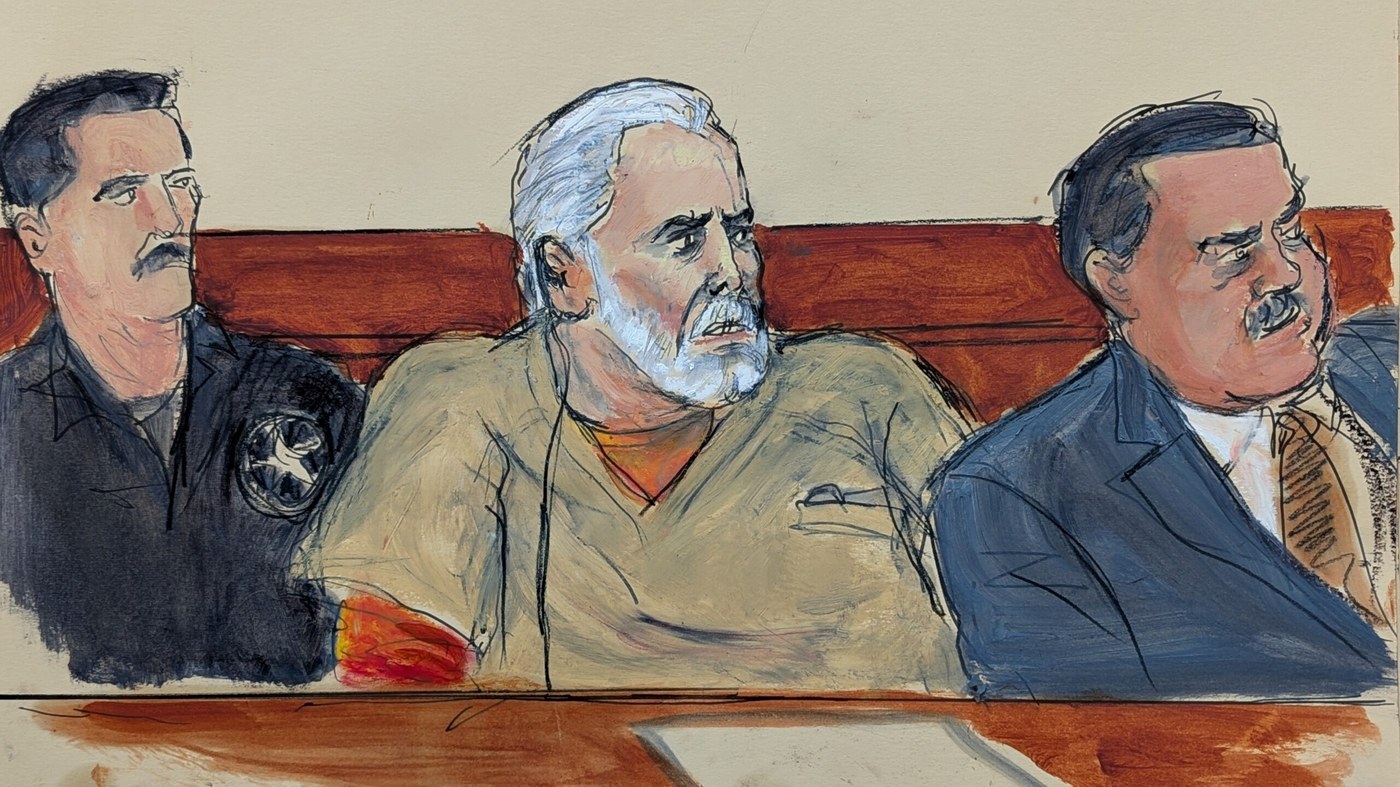
Ismael “El Mayo” Zambada, founding leader of the legendary Sinaloa cartel, was to be sentenced yesterday in New York, a ruling expected to send Mexico’s last old-school druglord to prison for life.
After a journey from poor farmworker to one of the world’s most powerful and wealthy criminal bosses, Zambada was arrested at a US airport in July 2024.
He claims he was tricked by a cartel ally into boarding a plane that delivered him into the hands of US authorities.
Known for keeping a low profile and avoiding being photographed, Zambada, now 76 years old, spent decades rising through the cartel ranks, evading both capture and multiple assassination attempts.
He was born in 1950 in Sinaloa — a rugged mountainous state of Mexico known for producing corn, beans, cattle and some of the world’s most notorious drug traffickers.
His early years coincided with the emergence of Sinaloa as a marijuana and opium growing region — and eventually a transit point for Colombian cocaine going to the US.
Mexico’s drug violence has surged since then.
Since 2006, almost half a million people have been killed, and 130,000 are missing, government estimates show.
Zambada began his criminal career with the Guadalajara and Juarez cartels, working alongside Miguel Angel Felix Gallardo and “The Lord of the Skies” Amado Carrillo Fuentes — both also from Sinaloa.
However, he eventually struck out, working alongside another Sinaloan, Joaquin “El Chapo” Guzman, to establish the Sinaloa cartel in the 1980s and 1990s.
With Zambada playing a key role in paying off officials, setting up distribution networks across the US, and moving billions of dollars back to Mexico, the Sinaloa cartel soon became the world’s largest.
It is one of six Mexican drug gangs that US President Donald Trump has designated as Foreign Terrorist Organizations.
US Court documents paint him as not just smart, but violently ruthless.
He allegedly ordered the killing of his own nephew, who was then found dead in a car by the side of the road.
US prosecutors said Zambada also engaged in “systematic assassinations” of fellow cartel members, police and the military.
In 2010, he gave a rare interview to the Mexican magazine Proceso, revealing that the Mexican army had come close to capturing him four times.
Known as the “man in the hat,” Zambada said that he feared jail more than death, and his arrest or murder would not change Mexico’s drug trafficking landscape.
Almost a year after being detained in the US, he pleaded guilty to drug trafficking and organized crime charges.
His former partner, Guzman, is already serving a life sentence in the US.
El Chapo’s downfall prompted an internal war within the Sinaloa cartel between Zambada’s supporters and El Chapo’s sons, which has left about 2,000 people dead.
El Chapo’s son, Joaquin Guzman Lopez, was on the same plane that brought Zambada to the US. Lopez was arrested and admitted to having kidnapped Zambada as part of his own plea deal.
The operation continues to raise questions nearly two years later, as well as tension between Mexico and the US over the FBI’s alleged participation.
The US has denied any role in the operation to bring Zambada onto US soil. However, the recent display of the aircraft that brought Zambada to the US as part of an FBI operations collection prompted Mexico to seek explanations.
A court in Brooklyn was expected to sentence him yesterday.
Under his plea deal with US authorities, Zambada faced a mandatory minimum term of life imprisonment without parole on a racketeering charge.
He also agreed to the forfeiture of US$15 billion of ill-gotten-gains as part of the plea deal, the US Department of Justice said.
INVESTMENT: The train project was significantly more expensive than other conventional services, but costs are expected to fall as the technology matures, an official said India yesterday launched its first hydrogen-powered train, joining a small group of nations testing the technology as part of efforts to decarbonize rail transport and cut dependence on fossil fuels. The project is part of a broader push to modernize one of the world’s largest rail networks while reducing carbon emissions. The 10-coach train runs along an 89km route between Jind and Sonipat in Haryana, powered by a 1,200-kilowatt hydrogen fuel cell propulsion system. The system is the world’s most powerful for a train, officials said. Hydrogen trains use fuel cells to generate electricity by combining hydrogen and oxygen, emitting only water and steam. “This
KEY REVENUE SOURCE: An agreement to freeze the bloc’s floating price cap on Russian oil also appeared elusive, despite a looming deadline today to reset the limit The EU on Monday failed to endorse a 21st sanctions package against Russia, putting the bloc at risk of undermining one of its key tools to restrict the Kremlin’s oil revenue. The main points of contention were restrictions on the transport of Russian liquefied natural gas (LNG) and measures regarding Austria’s Raiffeisen Bank International AG, said people familiar with the matter who spoke anonymously to describe the private talks. An agreement to freeze the bloc’s floating price cap on Russian oil — a central element of the package — was also elusive, despite a looming deadline today to reset the limit. Without
‘WRONGFULLY DETAINED’: A security expert said that China wants to use Chen Youlin’s expertise to improve its ability to conceal underground nuclear weapons tests A Chinese-born American seismologist who has published US-funded work on detecting North Korean nuclear tests has been detained in China for nearly two years and faces trial on spying charges, his wife, US lawmakers and two hostage advocacy groups said. The case of Chen Youlin (陳有林) adds an irritant to the tense relationship between the nuclear-armed rivals and comes as US President Donald Trump seeks to keep the relationship steady following last year’s trade war. US Secretary of State Marco Rubio on March 19 designated Chen, 54, as “wrongfully detained,” making his release a top US priority. The Trump administration has withheld
Artificial intelligence (AI) should not be dominated by a single country, Chinese President Xi Jinping (習近平) said yesterday at a major technology conference in Shanghai, urging international cooperation on its development. Chinese AI models are catching up to the most powerful US offerings and attracting global users with lower costs, but how to govern the sector has become a key question, as concerns grow over military AI deployment or its use by hackers and terrorists. “AI development should not be a solo performance by a single country, but a symphony of international cooperation,” Xi said at the opening of the World Artificial