You're reading Crypto Long & Short, our weekly newsletter featuring insights, news and analysis for the professional investor. Sign up here to get it in your inbox every Wednesday.
Note: The views expressed in this column are those of the author and do not necessarily reflect those of CoinDesk, Inc., CoinDesk Indices or its owners and affiliates.
This is your institutional newsletter, Crypto Long & Short. This week:
- Steve Neamtz of Yorkville America on what gold has that bitcoin is still building
- Top headlines institutions should pay attention to by Francisco Rodrigues
- “CHIP rebounds as USD.AI pivots to a loan factory” in Chart of the Week
…and if you’re looking for bitcoin meets Broadway: Crypto is taking the stage in New York City. “Bitcoin Bad Boy,” a comedy by Ben Schiller, runs Oct. 15-25 at the Chain Theatre. The show centers around a family in debt, a coder who wants to build a better world and a memecoin. Learn more.
Gold and bitcoin are allies against debasement
Gold trading near $4,200 an ounce alongside bitcoin
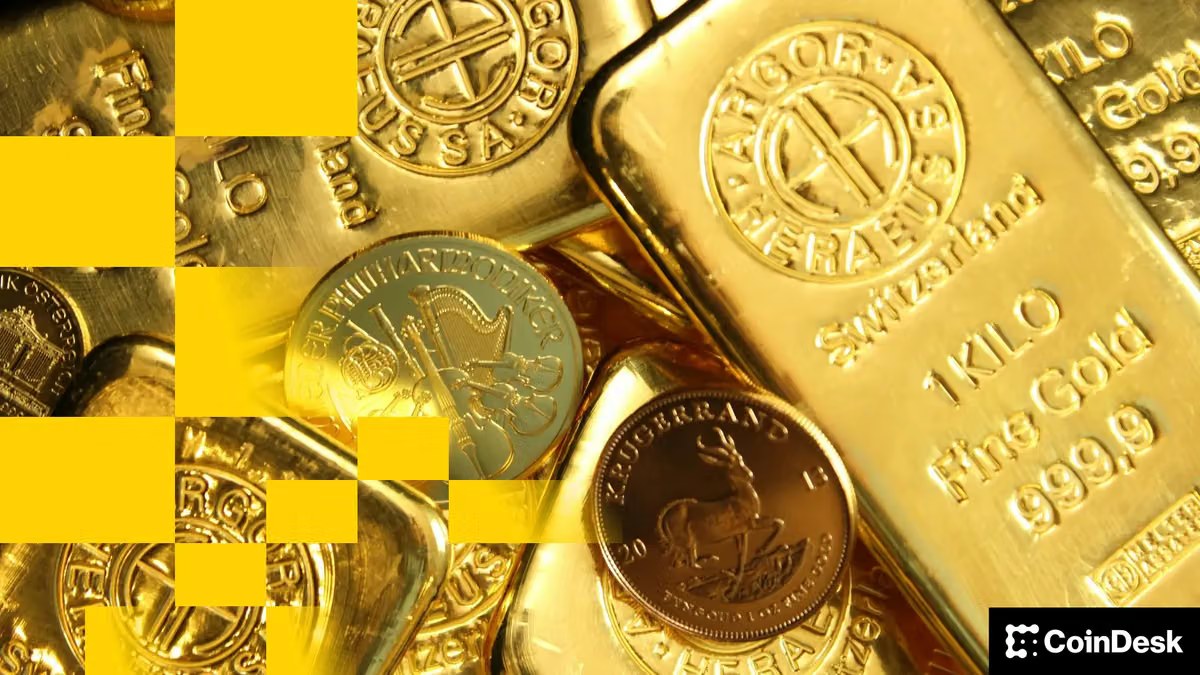
For 5,000 years, gold has demonstrated its value as a reserve asset. Bitcoin’s 17-year history offers far less empirical evidence. But the supply of both assets cannot be expanded by central bank or fiscal policymakers. Their shared scarcity thus takes on greater significance in a world awash in debt.
In the United States alone, the federal debt has climbed past $39 trillion. The U.S. now spends roughly $1 trillion a year simply servicing its existing debt, and the outlook is even more challenging for much of the developed world. Currencies often serve as the relief valve for fiscal concerns. The U.S. dollar, for example, has lost roughly 40% of its purchasing power over the past two decades.
Against this backdrop, it is important to understand where we believe supply-constrained assets fit within long-term diversified portfolios. A 2025 study in Resources Policy, using multifractal cross-correlation analysis across six asset classes — developed and emerging equities, bonds, commodities, energy and crypto — found that “neither gold nor bitcoin can be classified as a hedge or safe haven for financial markets” under rigorous testing.
That’s a finding about market-drawdown behavior — whether either asset reliably moves against stocks and bonds when markets fall. It says nothing about whether either holds value relative to a currency that is slowly, but steadily, depreciating against them. Investors and allocators buying gold or bitcoin often aren’t using them as shock absorbers. They’re making a debasement bet: that an asset independent of any government’s promise to pay provides diversification benefits.
On that bet, gold and bitcoin aren’t racing against each other — they’re at different points on the same course. Gold already has the custody, legal and reserve-eligibility infrastructure that lets central banks act on a debasement and reserve-currency diversification thesis today. Bitcoin doesn’t yet — at least not fully.
Gold’s lead reflects decades of built plumbing, not a stronger claim to the thesis. Bitcoin does not have the same penetration in terms of knowledge. It is earlier on the same curve, not a different one, and it often appeals to a younger generation of investors.
Central banks bought a record 289 metric tons of gold in the second quarter of 2026, after 244 metric tons in the first, according to data from an industry body funded by mining interests. This is worth flagging even as the pace of buying is independently corroborated elsewhere, and the clearest signal of where reserve managers are putting money and why. Bitcoin is being bought into the same thesis through a newer wrapper: spot ETFs, which solve the custody problem but not the sovereign-reserve status central banks need.
None of this requires picking a side. Central banks are buying gold on infrastructure that already exists; institutions are buying bitcoin on infrastructure still being built — the same debasement logic, two different stages. Financial media has already started calling it one trade, not two competing ones, as coverage of the “debasement trade” picked up through 2026. The right question for 2027 isn’t which asset wins. It’s how much of each diversifier belongs in a portfolio built for eroding purchasing power. The volatility is very different between gold and bitcoin, and we believe solutions that help investors with sizing these two anti-debasement assets will add value to portfolio construction efforts.
Headlines of the week
This week’s headlines show institutional crypto expanding through bank trading, regulated custody and national ETF access, while European regulators moved to force unauthorized stablecoins off trading platforms.
- EU gives crypto platforms three months to remove unauthorized stablecoins: The European Securities and Markets Authority (ESMA) told authorized platforms to block new trading and purchases of stablecoins that do not comply with the Markets in Crypto-Assets regulation (MiCA), with national regulators expected to resolve existing customer holdings within three months.
- Russia’s largest bank secures approval to trade crypto: Sberbank joined the country’s crypto exchange register and plans to open trading to all clients on Dec. 1, with bitcoin, ether and tether already being tested in its app.
- Ledger says spy chip in resold devices stole wallet recovery phrases: A covert implant in signers sold by reseller CryptoBilis read recovery phrases from device screens and sent them over a mobile network, with onchain researchers estimating up to $93.2 million lost across more than 300 wallets.
- Thailand opens its stock exchange to locally listed bitcoin and ether ETFs: Rules taking effect Oct. 16 will let domestic asset managers launch single-asset crypto funds, provided at least 80% of their net assets track bitcoin or ether and regulated custodians hold the tokens.
- Standard Chartered launches institutional RLUSD custody in Dubai: The bank now holds Ripple’s stablecoin for eligible clients and plans to connect those holdings to LMAX so they can serve as trading collateral without leaving the bank, subject to approvals and testing.
Chart of the week
CHIP rebounds as USD.AI pivots to a loan factory
USD.AI active loans dropped ~22% to ~$311 million on Oct. 2 and have been flat since, while CHIP has rebounded ~35% since Oct. 1 to ~5.8 cents (still ~48% below its April high). The catalyst is GLX, a loan-factory model (originate, sell performing loans to institutions, recycle the capital), which could drive a rebound in active loans by recycling capital into new loans without a much bigger balance sheet.
Looking for more? Receive the latest crypto news from coindesk.com and market updates from coindesk.com/institutions.
Diversified RWA stablecoins sustain 5-7% yield from real credit as crypto funding compresses to ~4%. GENIUS pushes yield off-chain; TAM grows to $4B in 3 years.