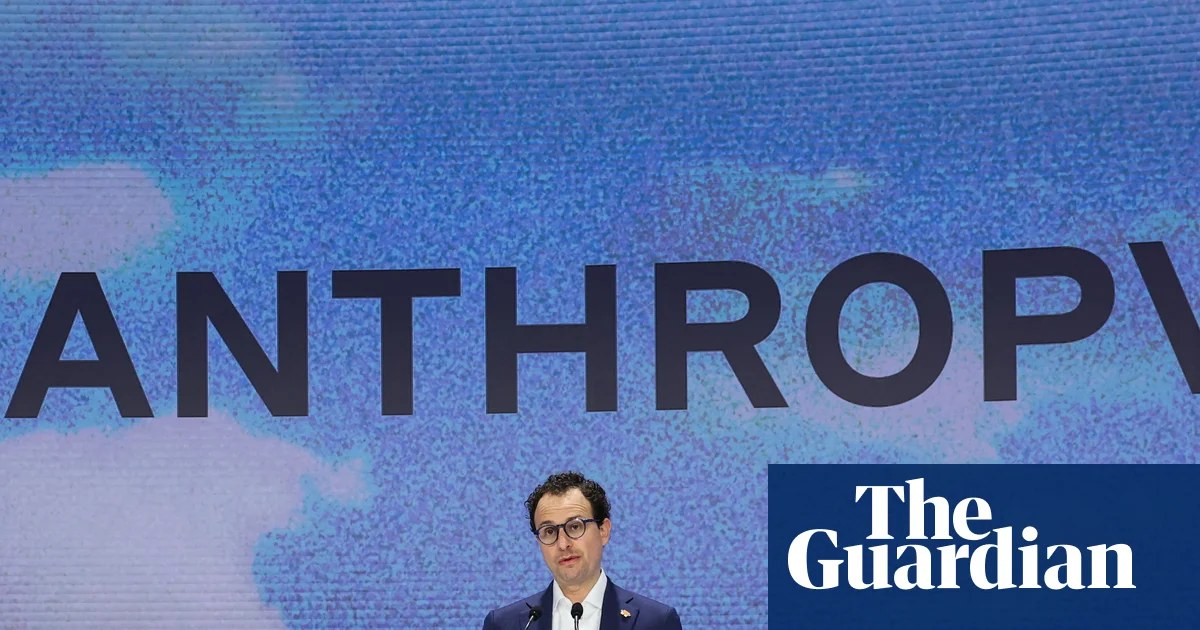
Below is the unofficial transcript of CNBC's exclusive interview with Anthropic co-founders Dario and Daniela Amodei today, Thursday, November 19, following the company's highly anticipated IPO. Following are links to video on CNBC.com: https://www.cnbc.com/video/2026/11/19/anthropic-ceo-on-scaling-laws-i-dont-think-we-really-believed-it-until-it-actually-happened.html, https://www.cnbc.com/video/2026/11/19/anthropics-debut-is-one-stop-on-the-journey-says-daniela-amodei.html, https://www.cnbc.com/video/2026/11/19/dario-amodei-weare-hoping-to-be-investment-grade-in-the-future.html, https://www.cnbc.com/video/2026/11/19/dario-amodei-on-if-jensen-huang-should-come-back-as-ceo-.html, and https://www.cnbc.com/video/2026/11/19/anthropic-sibling-founders-reflect-on-ipo-journey.html.
ANDREW ROSS SORKIN: Hey, thanks, Carl. Big day here. And I am here with the co-founders of this company, brother and sister. It's an unbelievable story, Dario and Daniela Amodei. Thank you for being here. Congratulations on this big moment.
DANIELA AMODEI: Thank you for having us.
SORKIN: Here's where I want to start this. When I first met you, you basically just practically started the company. And I'm so curious — you understood scaling laws at the beginning, perhaps better than anybody, but did you ever expect three, four, five years later here we would be and be talking about evaluation that starts with a T?
DARIO AMODEI: You know, the funny thing is, you look at the scaling laws and they're a line on a piece of paper, right? They predict that a model will have certain cognitive capabilities that will be capable of certain economic tasks. But it's one thing to kind of draw that line, and it's a totally different thing to see the consequences out in the world. And so I would say the scaling laws kind of imply that the technology and hopefully our work within it would — would have this scale. But I don't think we really believed it until it actually happened.
SORKIN: And it's happening right now. Daniela, this is now going to be the largest public benefit corporation to go public. What — for those folks who are watching this morning, even thinking about investing in the company, what does that mean, both for the company itself, but also the way investors should think about that?
DANIELA AMODEI: So, as a public benefit corporation, you know, part of why we decided to incorporate this way, is Anthropic mission is so much about how do we build something that is good for everybody? How do we really build for the public benefit? And part of what I think is so interesting about this structure is that we're actually legally required to balance shareholder interest with the public benefit, with the public good. And I think when Dario and I and our other co-founders were starting the organization, you know, we learned about this concept of a public benefit corporation. It really spoke to us, because we said, well, that's exactly what we're trying to do. We're really trying to do something that we do think can have this incredible economic value and impact, but we want it to be baked into essentially our structure that we also have to balance that against building things that are good for people.
SORKIN: OK, so here's the question. How do you balance the idea of growth and the idea of, for example, pacing at this point? This is something you have talked a lot about, pacing, given some of the safety concerns around AI? And how should the investor class think about those competing interests?
DARIO AMODEI: So, this, you know, this is one of the central tensions at the heart of the company. But it's really, because this technology is so powerful, it has so many effects in the world, it's something that every company in this space will have to face, whether they want to or not. We're just facing it more explicitly and more thoughtfully. And so, you think about something like pacing, the idea behind pacing was, you know, imagine that you have — you're driving your car at 60 miles an hour, and then you discover or invent something that could let you drive the car at 200 miles an hour, right? This is models building themselves, recursive self-improvement. What we have done with pacing is essentially said, look, you know, we could drive at 200 miles an hour. Maybe let's only drive at 90 miles an hour, spend time figuring out how to do that safely, and the rest of that surplus, we spend building the model in the right way. And you know, I think, in the long run, that will work out pretty well for the investors as well, because the company that builds the safest, that has trust of the customers and the enterprises of the world, I think that is the company that's going to be both best for society and, in the long run, I hope, best for the performance of the company. And I think that's what we often look for. We look for synergies, ways to make the two line up in the long run.
SORKIN: What does success look like today? When we see the price of this, do you say to yourself, if this is up 10 percent, 20 percent, that's success? If it's up too much, is that not success? What does, I mean, you guys have spent a lot of time with your bankers and—
DARIO AMODEI: I think that's one of the very few topics we're not allowed to talk about.
DANIELA AMODEI: I think, you know, I think maybe the way I would put it is, Anthropic has always been a very long-term-focused company, right? We have always been thinking about, how is this technology going to be beneficial to people in the future, but also what can it do for people today? And so while today is a super exciting milestone and we're obviously really, really excited about it, I think it's, for us, it's like one stop on the journey, right? We think about this as, wow, this is an incredible moment for Anthropic, for our mission, but we're going to wake up tomorrow and we're going to be the same company. And I think that's really, at least for me, what I have been focusing on today.
SORKIN: The rate of growth of this company has been extraordinary, but I want to understand the unlock and also understand the competition in the space, because, increasingly, you have open-weight models. You have competitors in OpenAI, which are trying to offer tokens at cheaper prices. You have folks like Microsoft, which offer your services, and yet are also trying to sell their own models. And they say oftentimes that some of those models, or at least some of the features of their models, can do some of the same things, maybe not at the frontier level. How do you think about that in terms of what that means longer term to the margins for the company?
DARIO AMODEI: So, I think, I think a couple concepts. One concept is the frontier. And we have found that there are these incredible returns to the frontier. And in most products or goods, you have competition on price. Here, the competition is really on quality, because the returns to greater cognitive ability are so high, right? As we climb the exponential of cognitive ability, you go from doing chatbots, to being able to do coding, to being able to do biology and robotics. And the economic value of things further along the frontier is so much larger than things earlier in the frontier that that's where most of the value accumulates. The second idea is that, if you're good at the frontier, you are also good at producing smaller and more efficient models away from the frontier. So, if you look at Haiku 5.5, we were able to drop the price by 4X from Haiku 4.5 and by many times from Opus and Fable 5 family, which are, which it's, which it's much cheaper than. And so we are able to also compete using our, the same technology that we build our models, models on the frontier, the same compute multipliers, to make these cheap models that compete away from the frontier.
SORKIN: In terms of a potential challenge, post-midterms, there's a big question about compute. How much compute is just even going to be allowed in terms of data centers being developed? How do you think about that? And do you think that's actually going to be a meaningful challenge going forward?
DANIELA AMODEI: One of the things that I think is really important to Anthropic is for it to feel to people like this technology is not happening to them. And I think, really, from our perspective, building data centers is something where we also need to listen to what it is that those communities want and help to bring forward that future as well, I think, in particular, really thinking about, how do we make sure that this, that any cost increase is not borne by the consumer? We have already committed to matching whatever price differential might happen from an electricity grid perspective, we pay for. I think that's just one example, but I think it's really important to us that we also go into these communities thoughtfully and that we engage with them in a way that makes this feel like it's good for everybody.
SORKIN: You have $900 billion, though, in commitments going forward. What is the path to profitability? And how long do you think you're going to have to continue to make these commitments? Is this a temporary phenomenon or a permanent feature?
DARIO AMODEI: Well, look, I would note first that those commitments are made over many years. So, if you look at the amount of cash we have on the balance sheet and the amount of revenue that we're already making per year, suddenly, those commitments don't seem so large. And we, again, we have a number of mechanisms to square those two. We have a difficult problem when we're trying to predict how much compute we're going to use. And we always, believe it or not, given that number, we actually try to err on the low side and buy more on the spot market if we need to. But the amount of R&D we need to do, the ability to train models with greater cognitive abilities, the returns to that are so high that we are willing to put in place these very large compute spends because, historically, we have seen over and over again that it pays off.
SORKIN: Between the money that you have cash on hand and the cash you're going to collect as a result of this offering, you might have about $250 billion, how do you think that's going to affect your investment grade rating in terms of your ability then to raise additional money in the future? Because that's important.
DARIO AMODEI: Yes. I think we're, we're, obviously, we will see how that turns out. At that, obviously, at some point in the future, we're hoping to be, we're hoping to be investment grade. And debt is an instrument that we have available to us and we'd like to use at some point in the future.
SORKIN: The other big question is liability in this era. We have talked about safety and cybersecurity and the like. You have talked about some things being almost existential. And you have been outspoken about some of the existential risks around AI. How should the investor, again, the investor class, think about those risks at a time when people like Satya Nadella will say that they don't believe anymore that sort of alignment is necessarily going to come with the scalability, that, ultimately, we're, they're going to need to create, you're all going to be needing to create new forms to almost police the models themselves?
DANIELA AMODEI: You know, one of the things I think about here and that we have really learned in our journey of scaling Anthropic, is how important our relationships with our customers are. And so much of what we have seen is that Anthropic has the ultimate responsibility to make sure that we're training the models in a way that is safe and responsible, that we have the appropriate safeguards in place, and, really, when we partner with our enterprise customers in particular, to say, how do we do that better for you?
DANIELA AMODEI: We have really, that, more than anything, has increased our ability to understand, what are the risk factors, what are the factors that a regular organization today using Claude might experience? And I think we have just learned so much from that process. The other thing I really want to say here, which we want to be super clear about, is, Anthropic has been a safety company, a safety-first company from day one. That is the entire reason we were founded, is we really, truly believe this technology is different than other technologies. The promise is incredible, and the risks are real.
DANIELA AMODEI: And we were really founded on this idea that it is our job to mitigate those risks, and I think we have to date done an incredible job doing that. We obviously have more work ahead of us, but we are deeply committed to safety. That's the whole reason we founded the organization.
SORKIN: How much personal pressure have you felt even in the past couple of weeks about this offering, this IPO? And I ask because the markets had a tough time. This is not the, you're not walking in with the wind necessarily against your back. We have had the situation with Nvidia and Jensen Huang. How have you even thought about that in this moment? Because people think of this company as sort of such a crucial piece of the puzzle.
DARIO AMODEI: We have been calm about it. We have been going on our road show. We have both been, we have both been doing interviews. And our picture of it is, we think we're building something great, and so the day-to-day, week-to-week, even month-to-month, it's less important than the fundamentals of what we're building. And I have said it before. I wrote it in the investor letter. We always want to under promise and overdeliver. That's a core thing. That's a core to the work we do inside the company. That's what we tell people when we recruit them. And that's how we want to operate as well.
SORKIN: I got to ask, because it's been in the middle of all this. Nvidia is an investor in your company and in this offering. At the same time, you have been on the other side of the issue with Jensen Huang as it relates to chips in China. And so what have you thought as you have watched this whole drama play out?
DARIO AMODEI: Yes, so I would say we have been a partner, partner to Nvidia for a long time. We work with them on data centers. We have had a long and productive partnership with them. And, of course, we're not always going to agree on policy issues with our partners. And so we have one policy position that comes from our conviction of where the technology is going. And we continue to hold that, and some of our partners have a different position.
DANIELA AMODEI: I would also just add, I think something that is a little bit unique about Anthropic is just how many different partners we work with for compute. So we work with Nvidia.
DANIELA AMODEI: But we also work with Amazon, with Google, with Broadcom. And I do think this has been helpful strategic advantage for us that we have so many different incredible partners who we get to work with together to design some of the best chips in the world.
SORKIN: Do you guys think Jensen should come back? I should ask.
DANIELA AMODEI: We're obviously not going to comment on anything about a competitor.
DARIO AMODEI: We're not going to comment. That's up to Nvidia. So—
SORKIN: Let me ask you a related question. You talked about partners. So, one of the partners that I spoke to yesterday was Elon Musk. And you use him for compute. And there's been some speculation that, when those contracts come up, or at least the first time they're available, you might try to scale back some of your use of SpaceX compute and move elsewhere. True? Untrue?
DARIO AMODEI: I mean, we don't, we don't, you can't be sure what you're going to do in the future, but we're finding that compute to be, to be high-quality. We're enjoying working with SpaceX.
SORKIN: And any update on where you are with the Pentagon right now?
DANIELA AMODEI: Obviously, nothing, nothing in particular to share. I think my feeling, honestly, at Anthropic is that we have always worked extremely well with the national security apparatus of the United States of America. We're very committed to ensuring that Claude is helping to protect the nation.
DANIELA AMODEI: We have had an incredible working relationship with that entire part of the government really since Anthropic was founded, and we expect that that will continue.
SORKIN: This is a big day for you. It's a big day for the company. It's a big day for the country, frankly. What is your mother doing right now?
DANIELA AMODEI: I hope you're watching. If you are, hi, Mom. I hope she's watching.
DARIO AMODEI: Hello. Hello, if you're watching, yes.
SORKIN: This is a brother-and-sister story. And so I'm just curious, for both of you on a very personal level, what this means.
DANIELA AMODEI: I think, in a lot of ways, Dario and I were talking about this beforehand. This is such an incredible milestone. It's such a huge moment for the company. We're so proud of what the team has done to get us here. And, also, we're the same company, and we're so excited to continue pursuing our mission. I think that's the thing we're both really focused on. And, also, we're hoping to be able to spend a little more time together, just the two of us, as siblings after this is over.
SORKIN: Guys, want to thank you. Want to congratulate you. We will, you had asked when that starts to change. Right now, it says UNCH. But we will be watching that number all day long. So, thank you both.